- Doctors gave Charlie just a 50 per cent chance of survival after discovering he wasn’t growing properly in the womb
- Born at 26 weeks weighing a mere 360 grams, Charlie became Queensland’s smallest surviving premature baby boy
- After 100 days in hospital, the miracle bub finally came home, proving the best things really do come in small packages
Here Samantha Jones, 26 tells her story in her own words.
Staring at the screen, the sonographer was seemingly puzzled by what she saw.
‘Your baby is very small,’ she began. ‘He’s around the 10th percentile.’
‘What does that mean?’ my husband Nick, 34, asked.
It was July 2025, and we were at my 14-week scan.
The sonographer reassured us some babies were simply small, and they’d monitor his growth.
But at 18 weeks, our baby had dropped to the second percentile and, two weeks later, below the first.
‘I’ll just get the doctor to come and take a look,’ the sonographer said, leaving the room.
My stomach flipped.
She returned a few minutes later with a doctor. ‘I’m so sorry, but your little boy has intrauterine growth restriction,’ the doctor said.
We stared at her blankly.
‘It means the placenta isn’t functioning properly, so your baby isn’t receiving the nutrients he needs to grow,’ she explained.
It was a terrifying catch-22. Our baby needed more time inside me to develop, but my failing placenta meant he couldn’t grow.
Delivered too early, he could be too tiny to survive.
‘This can’t be happening,’ I sobbed to Nick.
Nick and I had suffered a heartbreaking miscarriage just weeks after our wedding the previous year.
At eight weeks along, we’d discovered our baby had stopped developing at six weeks.
We cried for weeks before finally plucking up the courage to try again.
Then, just before my birthday in April, I fell pregnant again.
After passing 12 weeks, we’d finally allowed ourselves to get excited, even discovering we were having a boy.
But now it seemed our dreams might once again be shattered.
Our bub was in danger, and given a 50 per cent chance of survival.
Doctors set one crucial goal – our baby needed to reach 350 grams to have a fighting chance outside the womb.
Monitored weekly, I gave up my bookkeeping job, put myself on bed rest, and ate high-protein foods, hoping my beloved boy would get the nourishment he needed.
‘Eat up, little one,’ I told my tummy.
READ MORE REAL LIFE: Tiny Harry: ‘My premmie baby wore my ring on his arm’
In October, at 25 weeks and six days, our baby reached his goal weight, and I was admitted to Brisbane’s Mater Mothers’ Hospital where I was scanned daily.
Our bub stopped growing and, at 26 weeks and two days, his heart rate plummeted.
‘We’re having the baby now,’ doctors said, swarming around me as I was rushed in for an emergency C-section.
We’d been warned that our son would be whisked away immediately, because he’d be unable to breathe independently.
When doctors lifted him above the sheet, I could see he was so tiny.
They inserted a breathing tube and rushed him to the neonatal critical care unit, and Nick then ran backwards and forwards with updates as I recovered.
To my enormous relief, our baby was alive.
Twelve hours later, I finally saw our son lying inside a humidicrib. His eyes were fused shut and delicate veins showed beneath his thin, pink skin.
Still, he was beautiful – perfectly proportioned, only impossibly small.
We named him Charlie.
‘I love you so much, little man,’ I whispered. ‘Please keep fighting to grow big and strong.’
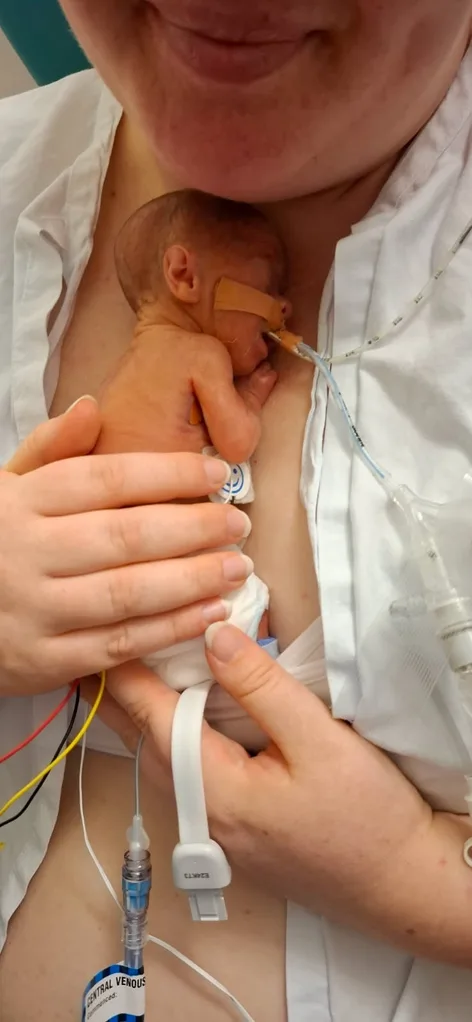
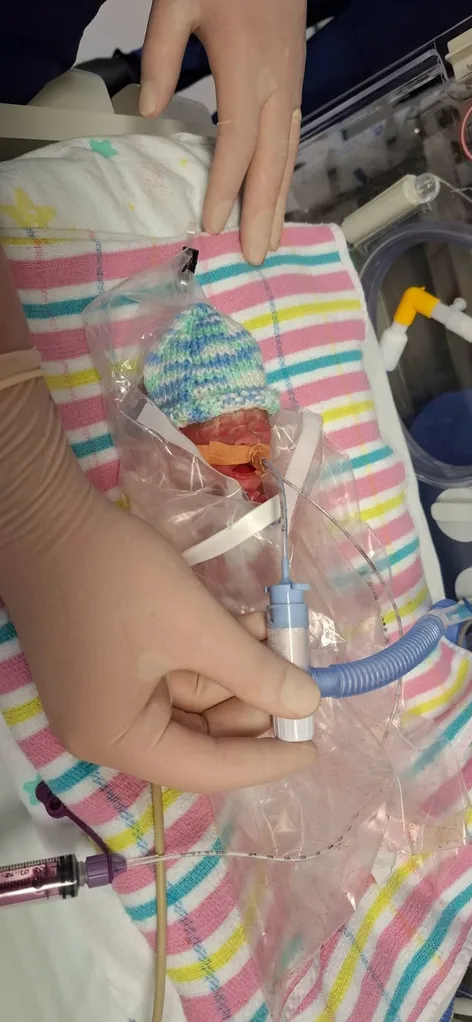
My hand covered his entire body and, weighing 360 grams, he was smaller than a can of Coke!
Our miracle boy was believed to be Queensland’s smallest-ever surviving baby, breaking a record that had stood since 1992. He was also Mater’s smallest-ever baby.
‘I can’t stop smiling,’ I beamed at Nick, who wore the same delighted grin.
I barely left Charlie’s side, reading stories, singing lullabies, talking to him, and expressing milk that was fed directly into his stomach, initially just 0.4ml at a time.
When Charlie’s eyes flicked open for the first time at four days old, I thought all my Christmases had come at once.
‘Hello, my darling,’ I cooed.
Two weeks after he was born, I got to have my first fragile cuddle.
Charlie was gingerly placed inside my bra against my chest for skin-to-skin contact.
His entire body disappeared inside as I stroked his tiny head beneath his beanie.
READ MORE REAL LIFE: Mum’s amazing story: My premmie baby was saved by a sandwich bag
Charlie remained on a ventilator for three weeks before progressing to CPAP and eventually nasal oxygen.
In December, weighing 1.5 kilos, he graduated to an open cot and could finally wear clothes, although even tiny size seven-zero outfits swamped him.
After 83 days at Mater Mothers’ Hospital, Charlie was transferred to Logan Hospital.
On January 16, 2026, his 100th day of life, Charlie weighed 1.7 kilos and was big enough to come home.
He looked like a tiny doll, completely dwarfed by his car seat.
Despite him still needing nasal oxygen and a feeding tube, we were finally one happy little family of three.
Taking him out for walks in his pram, I attached a sign that read, I’m a premmie. Your germs are too big for me. Please don’t touch me.
Two weeks later, Charlie was guzzling full bottles after he pulled out his feeding tube.
‘Well, he no longer needs that,’ doctors said.
It was a joy to see him flourish.
READ MORE REAL LIFE: Darling Daisy: The premature baby born tinier than a tub of butter
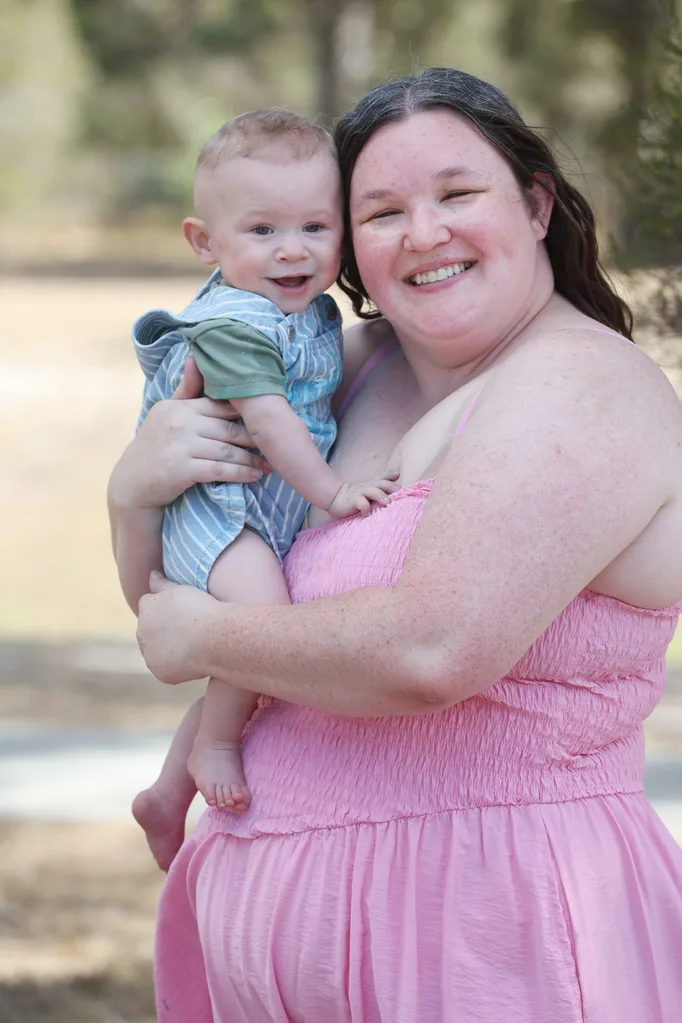
Now one, Charlie is still petite, on the second percentile, with a slight developmental delay normal for an extreme premmie, but he’s sitting independently, rolling and army crawling – especially when Thomas the Tank Engine or Bananas in Pyjamas is on TV.
The happiest little boy, he loves babbling and rarely cries unless he’s hungry or tired.
Charlie’s Queensland record has since been usurped by another tiny survivor, a baby girl, who weighed just 351 grams – only nine grams less than Charlie, but he remains the smallest surviving boy.
In every way, Charlie is our miracle.
From a 360-gram baby smaller than a can of Coke, he’s come further than we ever dared dream.
There’s no question: the best things really do come in small packages.
To donate to the Mater Foundation visit materfoundation.org.au


Related stories
Native ad body.
Native ad body.

Native ad body.