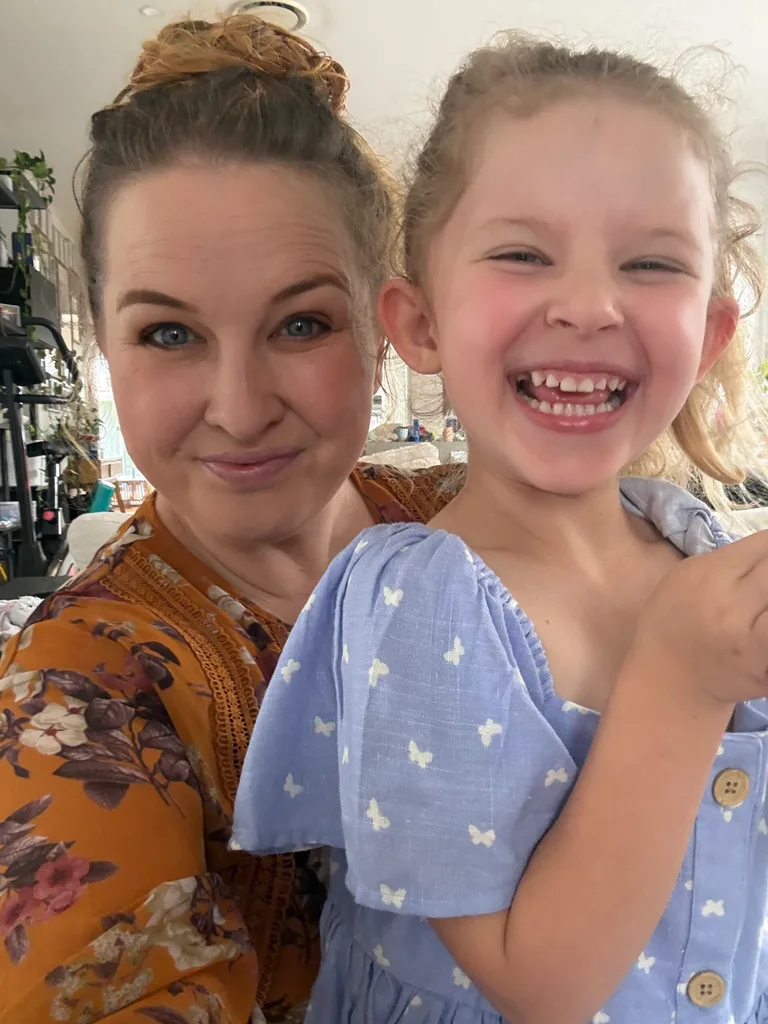


- When little Charlotte was diagnosed with Batten disease – a form of childhood dementia, Sarah Pardoe, 38, from Carrara, Qld, was heartbroken.
- Devastatingly, her baby is deteriorating before her eyes.
- Now age five, Charlotte is living on borrowed time.
Here Sarah tells her story in her own words.
Our twins April and Charlotte had been a happy surprise.
Already a mum to Lexie, then six, from my previous relationship, when I found out I was expecting in March 2020, I was over the moon.
At the six-week scan there was another surprise – it was twins!
When I told my hubby Mark, then 35, who’d had to work, his jaw hit the floor.
‘Two babies!’ he cried. ‘Woah!’
My pregnancy was cruisy and, as my belly grew, so did our excitement to meet the two little lives growing inside me.
‘They’re perfect.’
At 18 weeks we found out our fraternal twins were both girls. And on December 1, 2020, at 37 weeks, they came into the world via C-section – first Charlotte, then April just minutes apart.
‘They’re perfect,’ Mark said, beaming proudly.
Mark and Lexie were besotted with the bubs and before long we’d settled into life as a family of five.
As the girls grew their personalities began to shine.
April could talk from dusk to dawn while Charlotte was more of a cuddle bug.
But two months after the girls turned three, I noticed Charlotte started to have strange ‘glitches’.
READ MORE: ‘Mum’s heartbreak: ‘My kids have dementia’’

She’d be playing and then suddenly her eyes would glaze over as if she was staring into space.
‘Charlotte!’ I’d call out, but still nothing.
It’d only last a few seconds, but I was worried.
I told my GP who agreed we needed to keep an eye on it.
Then in February 2024, Charlotte had her first seizure at kindergarten.
Her body stiff, she violently shook.
‘It’s got to be something more.’
I was distraught when I heard the news.
Rushing her to emergency, there doctors assured us it was a freak seizure and if it happened again to bring her back in.
But that month she seized two more times and after doctors did an EEG brainwave test they said they thought it was epilepsy.
She was prescribed drugs to stop the seizures, but they only got worse.
Lasting between eight to 20 minutes, it was awful watching my little girl’s eyes glaze over as her body turned stiff and convulsed.
‘It’s got to be something more,’ I said to Mark.
READ MORE: ‘Dementia diagnosis: I thought my unsteadiness was an ear infection’

‘Let’s get her checked out,’ he agreed.
Worried, in April I took Charlotte to a private paediatrician who referred us to a neurologist.
Four weeks later, we were in her office.
‘If you notice a regression in her walking, talking and fine motor skills, let me know,’ she said, suggesting more tests, including an MRI.
Over the following weeks, Charlotte began to walk with a strange gait, and spoke less.
Six weeks later, in August her results arrived.
‘It’s likely she will only live until 14 years old.’
‘Charlotte has CLN2 Batten disease,’ she told me, explaining it was a very rare neuro-degenerative condition – a form of childhood dementia – where a missing enzyme causes a build-up of waste in the brain cells.
I listened, heartbroken, as she described how Charlotte’s fine motor skills would gradually decline, causing progressive vision loss, seizures, movement, speech and cognitive inability.
‘It’s likely she will only live until 14 years old,’ she said gently.
It felt like I was floating outside my body. It was so cruel – our toddler had been diagnosed with dementia… at just three years old.
In a daze, I phoned Mark at work to fill him in.
Stunned silence met me on the other end of the phone. ‘She’s strong,’ he then replied.
READ MORE: ‘Dementia carer’s devotion: ‘I knew he was in there’’

I was crushed when I learned Batten is a genetic condition caused when both parents are a carrier.
Mark and I had no idea.
This can’t be real, my mind swam.
In an instant all my dreams for Charlotte vanished.
She’d never fall in love, her wedding day would never come.
Our girl would likely never finish school.
That night Mark and I held one another as the shock wore off and the enormity of what we were facing kicked in.
‘We’re going to have bad days, but it’s not us against one another it’s us against this disease,’ I vowed, fighting back tears.
‘I love you and we will get through this,’ he promised.
As it’s genetic, I worried about April also being positive. But thankfully tests showed she’d dodged the deadly disease.
It felt like a silver lining when we found out there’s a treatment plan for CLN2.
That September Charlotte went into surgery where a port was inserted in her skull to start fortnightly infusions of the enzyme her body is missing.

The infusions have slowed the progress of her disease, but we know that it won’t last forever.
Charlotte also has hydrotherapy, physio, occupational therapy and speech lessons weekly.
And she does it all with a smile on her face.
With the cognitive ability of an 18-month-old, Charlotte’s vocabulary has become more limited – to about 20 words.
But she can still say our names and a handful of words like ‘hungry’, ‘car’, ‘sick’.
Now five, it’s been two years since our baby girl said, ‘I love you’.
Her vision is slowly getting worse, but she can still walk and feed herself.
We’ve explained to the other girls that Charlotte won’t live as long as them, so they make time to play with her, or we’ll go to the park or soft play centre.
It breaks my heart to know that while April is going to school and making friends, her twin won’t experience any of those same life milestones.
Through it all, Mark has been my absolute rock.